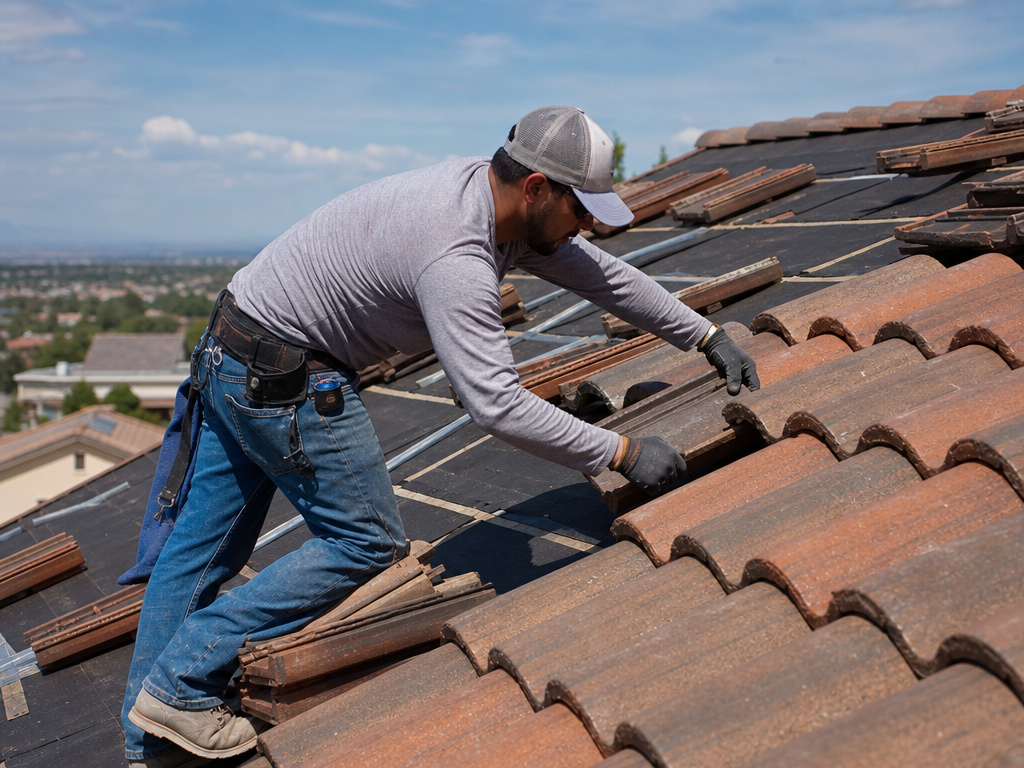
Denver's semi-arid climate with sudden hailstorms and winter freeze-thaw cycles demands tile roofs that start with a minimum 30-pound felt or synthetic underlayment rated for 90 mph winds. We double-layer underlayment in valleys and eaves, then install pressure-treated battens on 24-inch centers to allow airflow that prevents ice damming near Red Rocks Park elevations.
When replacing an existing roof on homes in Cherry Creek or Highland, we first verify decking integrity after tear-off, replacing any plywood compromised by previous leaks. Tile selection focuses on concrete Class 4 impact-rated pieces that meet Denver's updated building codes for hail zones; clay tiles are used only when the roof pitch exceeds 4:12 and the structure can handle the added weight.
Flashing around chimneys, skylights, and wall intersections uses 26-gauge galvanized metal with extended kick-out diverters to direct water away from stucco siding common in Capitol Hill. All penetrations receive butyl sealant under counter-flashing, and ridge vents are installed with matching tile caps to maintain attic ventilation without compromising the roof plane.
We pull permits under license 1241222 and schedule final inspections with the City of Denver before any crew leaves the site. Homeowners in Union Station-adjacent neighborhoods receive a written walkthrough of screw torque specs and tile overlap requirements so they can inspect the finished work themselves.
How it works
- 1
Site assessment and measurements
We measure every plane, note existing ventilation, and check for hail damage or rot on homes in Capitol Hill and Highland while confirming load capacity for tile weight.
- 2
Tear-off and deck preparation
Old roofing is removed down to the deck; damaged sheathing is replaced, then a self-adhering ice-and-water shield is applied on the lower six feet and all valleys before synthetic underlayment covers the field.
- 3
Batten and tile layout
Pressure-treated battens are fastened on layout lines, starter tiles are set along eaves, and full courses are installed with two fasteners per tile in high-wind areas near Red Rocks Park.
- 4
Flashing, ridge, and final inspection
Custom step flashing and counter-flashing are installed at all transitions, ridge tiles are set with vent inserts, and the job receives a final Denver building inspection before cleanup.
Pricing
Tile roof installation in Denver starts around $18 per square foot for concrete tile on a standard pitch; costs rise with steep slopes, complex valleys near the Denver Art Museum area, or required structural upgrades. Free written estimates are provided after an on-site visit.